Keweenaw Peninsula
Copper Harbor, Houghton, Hancock, and Brockway Mountain
Planning threshold Kp 4Checking NOAA
Dark skies and a north-facing Lake Superior horizon make this Michigan's strongest viewing region.
Live NOAA aurora forecast, peak time, and regional outlooks for the Upper Peninsula and Lower Peninsula
Michigan aurora visibility changes sharply by latitude, darkness, cloud cover, and the strength and timing of each geomagnetic disturbance. The Upper Peninsula has the best odds, while Lower Peninsula viewing usually requires a stronger event and an unobstructed northern horizon.
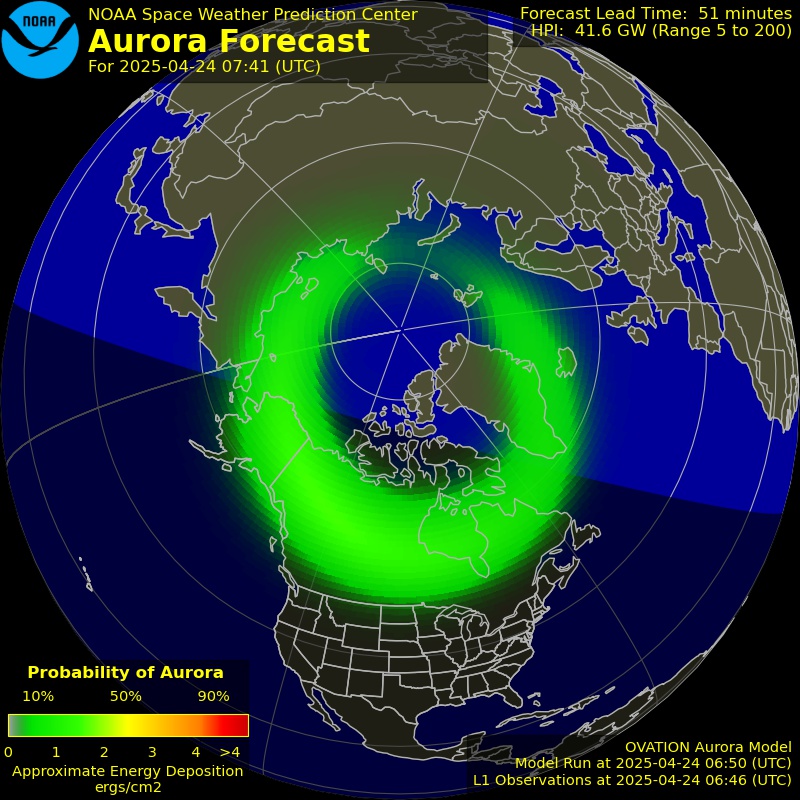
The tool below combines official NOAA Space Weather Prediction Center products with National Weather Service cloud forecasts and U.S. Naval Observatory moon data. Kp and Bz describe space weather; the added sky factors help answer when a regional trip is worth considering, without claiming a visibility probability. The page refreshes every 10 minutes, and the map ranks dark-sky viewing locations without collecting or storing your position.
Planning an autumn trip north? Pair daytime fall color with your northern lights viewing plans. Compare foliage timing and the aurora forecast before choosing your dates.
Checking NOAA's 30-to-90-minute OVATION nowcast and the next 24 hours of Kp guidance.
Copper Harbor, Houghton, Hancock, and Brockway Mountain
Dark skies and a north-facing Lake Superior horizon make this Michigan's strongest viewing region.
Marquette, Escanaba, and the central Upper Peninsula
Use Presque Isle or another dark north-facing shoreline and verify local clouds.
Munising and Pictured Rocks
Lake Superior beaches provide a dark northern horizon when park access and weather allow.
Sault Ste. Marie, Paradise, and Whitefish Point
Whitefish Point offers darker skies than the city and a broad view over Lake Superior.
Mackinaw City, Petoskey, and the Straits
Headlands International Dark Sky Park is the strongest nearby viewing option.
Traverse City, Gaylord, Alpena, and northern Michigan
Seek a dark shoreline with an open northern horizon and little city glow.
Bay City, the Thumb, and Saginaw Bay
Sleeper State Park provides the best north-facing water horizon in this region.
Detroit, Lansing, Grand Rapids, and southeast and west Michigan
Strong storms, darker rural skies, and a clear northern horizon are normally required.
Regional Kp numbers are conservative trip-planning thresholds used by this guide, not NOAA visibility guarantees. OVATION models the aurora 30 to 90 minutes ahead; the cloud percentages added here are NWS forecasts for representative regional grid points, not observations.
Your answer helps measure whether this planning tool is useful. It does not send your location.
Click below to share your location with this browser. The tool calculates straight-line distance to each viewing site and chooses the nearest forecast region. Exact coordinates stay in the browser; only the regional preference is saved on this device.
Click any marker for site detail. Markers are colored by Bortle dark-sky rating (darker = better aurora viewing). The Keweenaw, Lake Superior Provincial Park, and Whitefish Point are the three highest-leverage locations for serious aurora viewing.
The Kp index measures geomagnetic disturbance on a 0 to 9 scale. Higher Kp means the aurora oval has expanded south. The current peak forecast Kp is highlighted below.
Kp 4. Active conditions can support a low northern-horizon display from the northernmost Upper Peninsula when darkness, clouds, and local light pollution cooperate. A camera may capture color the eye misses.
Kp 5 (G1 storm). Worth monitoring from dark Upper Peninsula locations, but Kp alone does not guarantee a visible display.
Kp 6 (G2 storm). Can improve Upper Peninsula odds and may bring a low display to the northern Lower Peninsula on a clear, dark night.
Kp 7 (G3 storm). Can support viewing farther into the Lower Peninsula, especially away from city light with a clear northern horizon.
Kp 8-9 (G4-G5). Rare, severe-to-extreme geomagnetic storms that can push aurora much farther south. Local visibility still depends on darkness and weather.
The list below complements the map above. Ordered roughly by darkness and northern-horizon access. Use the geolocation tool to get distance-sorted recommendations from your specific position.
The fall and spring equinox periods (March through April and September through October) produce statistically more aurora activity due to favorable Earth-Sun magnetic alignment. The Russell-McPherron effect roughly doubles the probability of significant geomagnetic activity during these windows. Midsummer is the hardest aurora-viewing season in Michigan, not because the aurora is less active but because the fully dark window is much shorter than it is in fall and winter.
Optional field gear
These categories address the practical problems in the photography guide above: stable long exposures, preserving night vision, staying warm, and keeping batteries alive in the cold.
Paid links: As an Amazon Associate I earn from qualifying purchases.
Keeps a camera or phone steady for the 5–20 second exposures described above.
See current options on AmazonHelps with camera setup and walking while preserving more of your dark-adapted vision.
See current options on AmazonMake a long wait beside an exposed Michigan lakeshore more comfortable in cold weather.
See current options on AmazonProvides backup power for a phone or rechargeable gear when cold weather shortens battery life.
See current options on AmazonThe aurora is produced when charged particles from the Sun (carried in the solar wind and the coronal mass ejections that periodically erupt from sunspots) reach Earth and are channeled along magnetic field lines into the upper atmosphere. The particles collide with atoms of nitrogen and oxygen at 60 to 200 miles altitude. The collisions excite the atoms; as they return to ground state they emit light, primarily the green of excited oxygen at 558 nanometers and the red of excited oxygen at higher altitudes. Purple and pink at the bottom edge of curtains come from nitrogen.
The Kp index measures the global geomagnetic disturbance in three-hour intervals. The Bz component of the solar wind magnetic field is a better near-term predictor: when Bz is strongly southward (large negative values, typically below minus 10 nanoteslas), aurora is much more likely in the next 30 to 60 minutes regardless of what the Kp forecast said earlier. Solar Cycle 25 reached solar maximum in late 2024 and is now declining toward the next minimum around 2030. 2026 is still well within the high-activity window.
How often can I see the aurora from Michigan?
There is no dependable monthly count. Visibility changes with solar activity, latitude, cloud cover, darkness, moonlight, and local light pollution. The Upper Peninsula generally has more opportunities than southern Michigan, so use the live NOAA outlook and local sky conditions for each night.
What does Kp need to be for me to see aurora from where I am?
This guide uses Kp 4 to 5 as an Upper Peninsula planning signal, Kp 6 for the northern Lower Peninsula, and Kp 7 or higher farther south. Those are conservative planning thresholds, not visibility guarantees. Always confirm the NOAA short-term oval, darkness, and local clouds.
Why is Bz important?
Bz is the north-south component of the solar wind's magnetic field. A sustained southward, negative Bz can help energy couple into Earth's magnetosphere, but it is only one input. Read it alongside solar-wind speed, Kp, the NOAA short-term oval, and local sky conditions.
How accurate is the 3-day Kp forecast?
Confidence generally falls as the forecast extends farther out. Use the three-day Kp outlook to plan, then recheck NOAA's 30-to-90-minute OVATION model, real-time solar wind, and local clouds before traveling.
Can I see colors with my eyes?
Sometimes. Cameras often capture more color than human vision, especially during a faint display. What you see depends on the display's strength, your dark adaptation, light pollution, and cloud cover, not a single Kp cutoff.
Will the notification feature work for me?
If you enable notifications using the button at the top of the page, your browser will alert you when the live Kp data crosses 5 (G1 storm threshold) while you have the page open. For background alerts when the page is not open, third-party services like SpaceWeatherLive or AuroraAlerts apps are required.
Is fall a good time to see the aurora in Michigan?
Yes, and specifically the weeks around the September equinox. Geomagnetic activity runs statistically higher near both equinoxes, a pattern called the Russell-McPherron effect, and fall brings longer nights than summer. In the Upper Peninsula that window also overlaps peak fall color. The tradeoff is cloud cover, which builds along the Lake Superior shoreline while the water is still warm.
The three-night outlook above answers this directly: it reads the NOAA Space Weather Prediction Center forecast forward and gives each of the next three nights its own verdict, so on a Thursday it is already telling you about Friday and Saturday. Two honest limits are worth knowing before you book anything. Aurora forecasting is only reliable about one to three days out, so a weekend read taken on Monday is close to guesswork and a read taken Thursday or Friday is worth acting on. And a strong Kp number is only half the answer: the storm has to peak while it is actually dark in Michigan, the sky has to be clear, and the moon has to be low or thin. If you are driving north specifically for this, watch the outlook Thursday, then check again the afternoon you leave.
Yes, and more often than most people expect. What decides it is the Kp index, a 0 to 9 scale of geomagnetic disturbance published by the NOAA Space Weather Prediction Center. The Upper Peninsula sits far enough north that a moderate storm, around Kp 5, will put the aurora borealis on the northern horizon from a dark shoreline. Northern Michigan needs roughly Kp 6. The southern tier around Detroit, Lansing, Grand Rapids and Kalamazoo needs a strong storm at Kp 7 or above, and at that strength the display usually sits low in the north rather than overhead. Three things have to line up with the Kp number: full darkness, a clear northern sky, and a moon that is not washing out the horizon. Michigan gets more chances than its latitude suggests because the Great Lakes give so many places an unobstructed view north over open water.
Anywhere with a dark, unobstructed view north over water, which is why Michigan does better than its latitude alone would suggest. The strongest sites are Copper Harbor and Brockway Mountain in the Keweenaw, Whitefish Point near Paradise, the Headlands International Dark Sky Park just west of Mackinaw City, and the Lake Superior shore around Marquette and Munising. All of them combine high latitude with open water to the north and very little town glow. In northern Michigan the Lake Michigan shoreline north of Traverse City works, as does the Lake Huron shore near Alpena. Further south, the limit is light pollution rather than latitude: get well clear of Grand Rapids, Lansing and Detroit and find a north-facing lakeshore. Face north, give your eyes twenty minutes to adjust, and remember that a camera on a long exposure will show colour the naked eye reads as pale grey.
This page reads the NOAA Space Weather Prediction Center forecast forward and gives each of the next three nights its own verdict, so you can tell whether tonight is the night or whether it is worth waiting for tomorrow. It matters because the headline Kp number is a three-hour figure that often peaks in daylight, when it is no use to anyone standing outside in Michigan. The outlook takes the same forecast and reports the strongest Kp that falls inside the hours that are actually dark here, along with when that window opens and closes. Even near the summer solstice, the Straits briefly reach astronomical darkness, but the fully dark window is much shorter than it is in fall and winter. Aurora forecasting is only reliable a day or two ahead, so treat the third night as a rough signal and check again.