Live northern lights conditions across the Turtle Mountains, prairie and Badlands of North Dakota.
—
Viewing score
Tonight in Turtle Mountains & Peace Garden
Loading live conditions…
Checking NOAA aurora activity, local clouds, darkness, solar wind and moonlight.
Aurora signal—
Best sky—
Peak Kp 24h—
Current Kp—
Solar wind speed—
Bz GSM—
Moon illuminated—
What this score means
The 0–100 number is our viewing score, not a percent chance. It combines NOAA space-weather signals with local NWS sky cover, darkness, moonlight and North Dakota regional thresholds.
North Dakota Regional Outlook
North Dakota's northern latitude and broad dark horizons make it a strong aurora state. Local clouds and haze can matter more than city-to-city differences.
Live aurora visual desk · North Dakota
The northern border, open prairie, or the Badlands?
The lowest northern horizon can be decisive. Far-northern Turtle Mountains may work during activity too weak to reach the southern Badlands.
Explore the viewing regions
Choose a marked region to update the live Viewing Score at the top of this page. Pin locations are regional reference points, not exact public parking or viewing entrances.
Loading the key-free dark map…
Select a region to see its forecast threshold and the current NOAA signal.
Prairie and Badlands travel requires legal overnight access; map points show planning regions rather than park entrances.
Find one of the viewing locations in the field guide
These are genuine places researched below. Each link opens a location-name search on OpenStreetMap; it is not a verified gate or parking-pin coordinate.
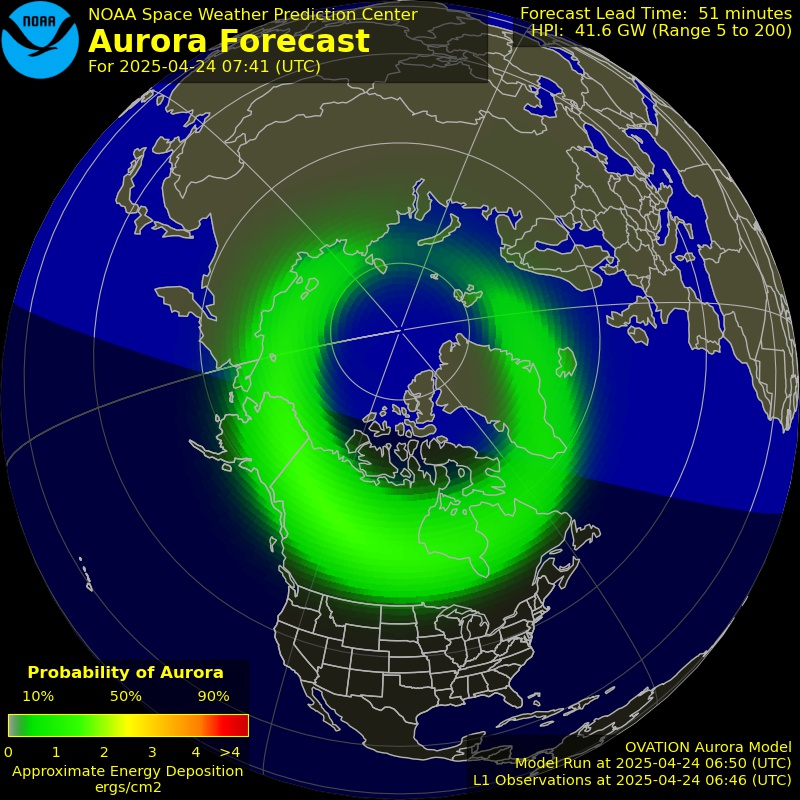
NOAA aurora oval · Northern Hemisphere
This is NOAA's current modeled auroral oval, not a live photograph or a promise of visibility. Zoom your eyes toward North America to see how far south the oval reaches.
NOAA updates its aurora nowcast independently of this page.
Every bar is a NOAA 3-hour Kp sample. The dashed line marks the planning threshold for the region you select above; it is not a visibility probability.
Waiting for NOAA forecast samples…
Below local planning KpAt/above planning KpReference level
North Dakota regional outlook: what the Kp numbers mean
Open prairie makes North Dakota good for a low aurora on the north horizon, especially near the Canadian border. The live engine's Kp figures are thresholds for checking conditions, not reliable visibility cutoffs: clarity, moonlight and local light still govern the result.
Turtle Mountains and Bottineau — Kp 3. Bottineau, Lake Metigoshe and the Peace Garden vicinity sit close to Canada; lakes and selected open lookouts improve the horizon.
Pembina and far northeast — Kp 3. Pembina and Cavalier benefit from northern latitude; the Pembina Gorge has darker country but trees and slopes can obscure the view.
Minot and north-central prairie — Kp 4. Minot, Rugby and rural US-2 country have broad fields; get clear of town glow and avoid stopping on highway shoulders.
Devils Lake and north-central lakes — Kp 4. Devils Lake and Grahams Island offer water horizons with fewer obstacles than wooded sites.
Grand Forks / Red River Valley — Kp 4. Grand Forks and nearby open farmland have a low northern horizon, but urban lights reduce contrast.
Badlands and south-central — Kp 5. Medora, Theodore Roosevelt National Park and Bismarck need more expansive activity; the badlands are darker but farther south.
Where to watch the northern lights in North Dakota
These are real parks, overlooks or public-use areas, not verified open entrances tonight. A certified Dark Sky Park or Sanctuary means protected darkness, not that every viewpoint is Bortle 1 or 2. No precise Bortle class is asserted here without site measurements. Check conditions, land rules and night access before heading out.
Mystical Horizons, near Bottineau. A named stone-skyline installation in the Turtle Mountains recommended by North Dakota Tourism for aurora viewing.
Lake Metigoshe State Park. Lakes and year-round camping in northern North Dakota. Use a permitted lakeshore or campsite rather than a wooded trail after dark.
Crow Flies High Butte, near New Town. North Dakota Tourism's named aurora overlook; broad views over the Lake Sakakawea landscape, with exposed terrain.
Pembina Gorge, Tetrault Trail viewpoint. Official tourism-recommended stargazing location. The trail can be hazardous at night; only visit when appropriate and accessible.
Grahams Island State Park, Devils Lake. A real Devils Lake island park; find an approved shoreline away from campground lights and verify access hours.
Theodore Roosevelt National Park — Buck Hill. National tourism guidance specifically identifies this elevated viewpoint; night sky can be dark but low aurora takes stronger activity.
Theodore Roosevelt National Park — Oxbow Overlook. Another named park overlook in the North Unit; verify seasonal road access and avoid roadside stops.
Sheyenne National Grassland. Wide prairie skies in southeastern North Dakota; farther south so best reserved for strong geomagnetic storms and a legal public access site.
Best months and hours for aurora in North Dakota
September through March is the most reliable viewing season in terms of hours of darkness, with late fall and early spring often more comfortable than midwinter. June's late sunsets make faint aurora harder to detect. Start watching around 9 p.m.–2 a.m. Central Time (much of southwest North Dakota is on Mountain Time). The open prairie can be bitterly windy, and drifting snow, fog, dust and agricultural haze are as relevant as Kp.
Aurora photography basics
A tripod matters more than a long lens. Start with a wide lens, focus manually on a bright star, and shoot RAW if possible. Try a 5–10 second exposure, a wide aperture (about f/2.8), and ISO 1600–3200; shorten the shutter to 1–3 seconds if the curtains move quickly. On a phone, use its night or manual mode with the phone braced on a tripod. Check each frame for sharp stars before taking a whole sequence. Bring a red headlamp, spare batteries and warm layers; a camera can record faint color that your eyes see only as a pale glow.
North Dakota northern lights FAQ
How often are the northern lights visible in North Dakota?
They occur irregularly. Northern-border sites can see them with moderate activity; more southerly places need stronger displays.
What Kp do I need in Bottineau?
Kp 3 is the engine's first planning trigger for the Turtle Mountains, not a guarantee. The 30-minute NOAA oval and local sky are better final checks.
Can I see them from Fargo?
Sometimes during stronger events. The Fargo region begins at Kp 5 as a planning benchmark; travel to a legal dark rural spot helps with light pollution.
Which is better: Peace Garden or Theodore Roosevelt?
The Canadian-border latitude is an advantage for weak activity. Theodore Roosevelt offers outstanding dark sky but normally needs the aurora oval to spread farther south.
Are state parks open for midnight aurora watching?
Not all day-use areas are. Confirm gate, campground and overnight rules before going; never enter a closed viewpoint.
Compare the northern Turtle Mountains and Pembina first, then use the Badlands and central/southeast cards to decide whether travel is justified. Theodore Roosevelt is included for exceptional dark sky even though it sits farther south.
North Dakota northern lights by location
Know where you plan to watch? Open a local page that locks the same live state engine to that location.