Eagle Beach recreation area
A known Juneau-area public coastal destination; check timing, tide, parking and the actual northern outlook.
A favorable planetary Kp number may still be useless behind a coastal cloud layer or steep mountain horizon. Give Juneau cloud and darkness a stricter gate than you would use for Fairbanks; do not promise a sighting.
Use the regional map, the latest NOAA auroral-oval model, and the real 72-hour planetary Kp forecast together with the live local cloud and darkness assessment above. They are planning tools, not a sighting guarantee.
The highlighted marker represents the Juneau & Southeast forecast region. Other markers are regional model reference points, not suggested parking locations. Select a marker for that area’s own forecast.

Showing the region behind this live local forecast. Map markers are broad modeling centers; use the location-name search links and check legal access before traveling.
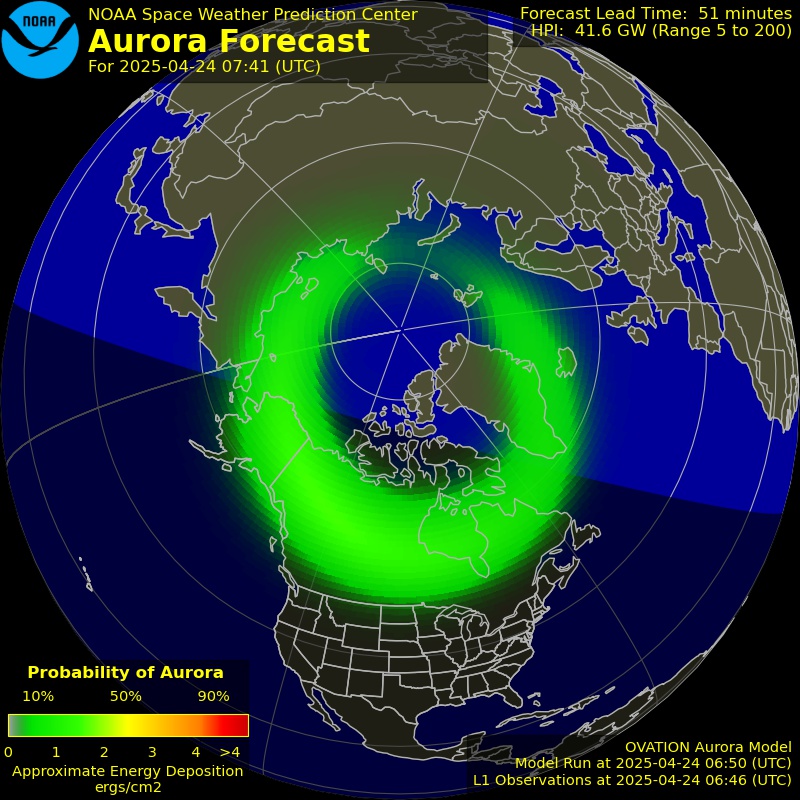
NOAA’s Northern Hemisphere 30-minute model. The illuminated band indicates modeled auroral activity, not a local camera or visibility probability.
Three-hour samples from NOAA, plotted against this region’s approximate Kp 3 planning threshold. The line is not a hard cutoff.
Where the sky actually opens: Coastal rain clouds and forested ridges often matter more than Kp. A fully overcast sky vetoes aurora even in a geomagnetic storm.
When the forecast is worth acting on: Use the Juneau regional cloud forecast and lower-latitude Kp planning trigger instead of general Alaska aurora optimism.
Access before adventure: Wildlife, icy roads, nighttime trail rules, tides and glacier-region safety all matter; choose a known public access point.
Forecast coverage: This page shares the live NOAA/NWS regional model for Juneau & Southeast, not an instrument or guaranteed sky report at Juneau. Conditions at a lake, mountain, coast, or remote campsite may differ. The Kp 3 line is a planning benchmark, not a viewing probability.
Juneau is one of Alaska's most recognizable outdoor cities, surrounded by mountains, glaciers and marine wilderness. Its southeast coastal setting is often cloudier than Interior Alaska, so simply being in Alaska does not make a Juneau aurora night likely.
This page uses Kp 3 only as an approximate regional planning benchmark. Kp is planetary, not a local guarantee. NOAA OVATION, local clouds, darkness, moonlight, light pollution and horizon quality can matter just as much.
Juneau is reachable by boat or plane, not a highway from Anchorage or Fairbanks. Confirm public access and local weather before planning remote shore outings.
A known Juneau-area public coastal destination; check timing, tide, parking and the actual northern outlook.
Broad sky openings may outperform forested trails, though valley cloud remains a limitation.
Accessible town-edge areas can be preferable to unsafe remote drives, but city glow and mountains reduce viewing.
A favorable planetary Kp number may still be useless behind a coastal cloud layer or steep mountain horizon. Give Juneau cloud and darkness a stricter gate than you would use for Fairbanks; do not promise a sighting. Check the live NOAA/NWS signal and dark-sky window above before leaving; a viewing score is not a probability.
Eagle Beach recreation area: A known Juneau-area public coastal destination; check timing, tide, parking and the actual northern outlook. Juneau is reachable by boat or plane, not a highway from Anchorage or Fairbanks. Confirm public access and local weather before planning remote shore outings.
Kp 3 is an approximate planning trigger for the Juneau & Southeast forecast region, not an observation or a cutoff. The local viewing score also uses cloud, darkness, moonlight and NOAA OVATION.
Wildlife, icy roads, nighttime trail rules, tides and glacier-region safety all matter; choose a known public access point. Verify the current operating hours and permissions with the destination before travel.
Coastal rain clouds and forested ridges often matter more than Kp. A fully overcast sky vetoes aurora even in a geomagnetic storm. Even strong solar activity is blocked by opaque cloud or insufficient darkness.
Open the full Alaska northern lights tool →
The Viewing Score is a 0–100 planning index, not a percent chance. NOAA OVATION is modeled aurora signal rather than a local sighting probability. Missing live values stay missing.