Live aurora activity, clouds, darkness and viewing windows across Alaska.
—
Viewing score
Tonight in Fairbanks & Interior
Loading live conditions…
Checking NOAA aurora activity, local clouds, darkness, solar wind and moonlight.
Aurora signal—
Best sky—
Peak Kp 24h—
Current Kp—
Solar wind speed—
Bz GSM—
Moon illuminated—
What this score means
The 0–100 number is our viewing score, not a percent chance. It combines current NOAA space-weather signals with local NWS sky cover, darkness, moonlight and viewing thresholds for the selected Alaska region.
Alaska Regional Outlook
Alaska sits under and near the auroral oval, so even modest geomagnetic activity can produce displays. Summer daylight is often the limiting factor.
Live aurora visual desk · Alaska
Fairbanks, Denali, Anchorage, or the far north?
Much of Interior Alaska lies under or near the auroral oval; a low Kp can still matter. In May–July, darkness rather than space weather is often the limiting factor.
Explore the viewing regions
Choose a marked region to update the live Viewing Score at the top of this page. Pin locations are regional reference points, not exact public parking or viewing entrances.
Loading the key-free dark map…
Select a region to see its forecast threshold and the current NOAA signal.
In Alaska the lights may be overhead or south, not just north. The markers represent large viewing regions, not safe road pullouts.
Find one of the viewing locations in the field guide
These are genuine places researched below. Each link opens a location-name search on OpenStreetMap; it is not a verified gate or parking-pin coordinate.
NOAA aurora oval · Northern Hemisphere
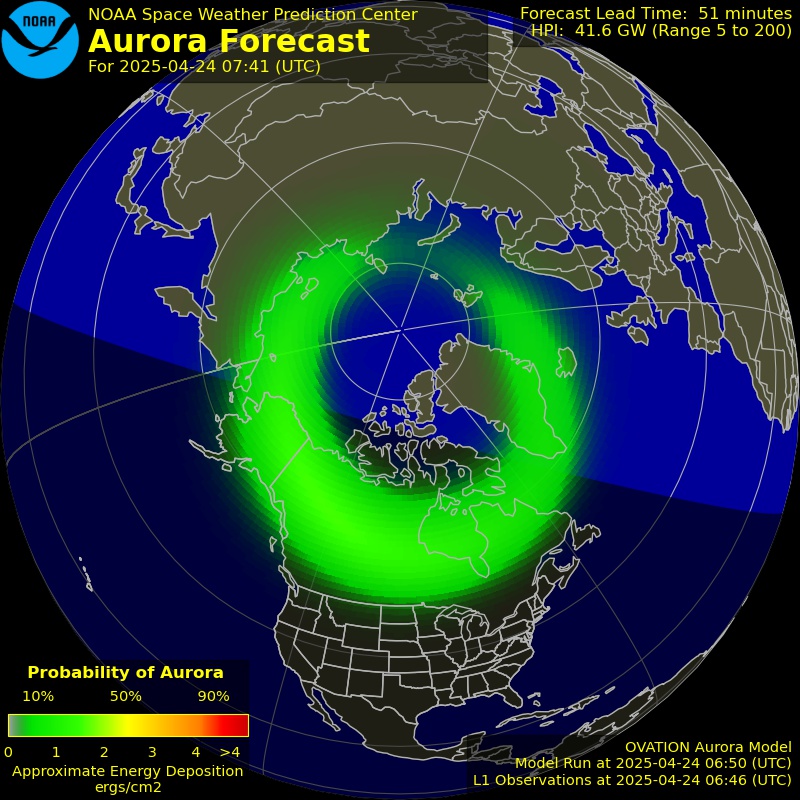
This is NOAA's current modeled auroral oval, not a live photograph or a promise of visibility. Zoom your eyes toward North America to see how far south the oval reaches.
NOAA updates its aurora nowcast independently of this page.
Every bar is a NOAA 3-hour Kp sample. The dashed line marks the planning threshold for the region you select above; it is not a visibility probability.
Waiting for NOAA forecast samples…
Below local planning KpAt/above planning KpReference level
Alaska is not simply the Lower 48 with lower Kp numbers. Fairbanks and the Brooks Range sit under or near the auroral oval, so displays can occur while planetary Kp is quiet. A Kp 0–1 planning trigger is meaningful here only if it is fully dark and clear. At these latitudes the aurora may be overhead or even to the south; scan the entire sky.
Coldfoot, Wiseman and Brooks Range — Kp 0. Far above the Arctic Circle and close to the oval, faint aurora is possible during otherwise quiet planetary conditions. Summer's continuous twilight or daylight can make it invisible.
Fairbanks and Interior — Kp 1. Fairbanks, Cleary Summit and Chena Hot Springs lie in a favored auroral zone. Clear, dark skies matter more than chasing a dramatic Kp value.
Nome and Seward Peninsula — Kp 1. Nome shares high latitude and a vast northern horizon; Bering Sea clouds and coastal wind can be the limiting factors.
Denali, Healy and Cantwell — Kp 1. Denali's interior latitude is favorable and park skies are dark, but winter road closures make a front-country night plan essential.
Anchorage and Mat-Su Valley — Kp 2. Anchorage, Eagle River and Palmer sit south of Fairbanks; city glow and Chugach topography favor a clear public viewpoint outside bright urban areas.
Juneau and Southeast Alaska — Kp 3. Juneau, Gustavus and Glacier Bay are farther south and much cloudier. Consider the aurora only when both geomagnetic activity and a rare clear-night window line up.
Where to watch the northern lights in Alaska
These are real locations, not live-confirmed accessible viewing sites. Designated dark-sky land can have exceptionally low light pollution without every point having an independently verified Bortle class. No exact Bortle number is claimed here. Confirm overnight access, road and land restrictions before you go.
Cleary Summit, Steese Highway. A Fairbanks-area aurora location specifically recommended by Travel Alaska. Elevated and exposed; road ice and snow must be checked.
Murphy Dome, northwest of Fairbanks. Another named Travel Alaska aurora destination with broad views and little city light. Conditions can be severe at the summit.
Chena Lake Recreation Area, near North Pole. A documented local aurora spot east of Fairbanks; lower driving commitment than mountain overlooks.
Chena Hot Springs Resort. A real aurora destination east of Fairbanks with overnight options. It is commercial property, so check booking and access rules.
Wiseman / Coldfoot overnight viewing areas. Established Dalton Highway aurora country beneath the northern oval. Observe from authorized lodging or safe public areas; the Dalton Highway is not a casual winter night drive.
Denali — Riley Creek Campground / front country. A real year-round camping option near the park entrance. Much of Denali Park Road is closed in winter, so remain in accessible front-country areas.
Point Woronzof, Anchorage. A public bluff above Knik Arm identified by Alaska travel guides. Open northwestward views, though nearby airport lighting limits sky contrast.
Talkeetna riverfront area. Recognizable upper Susitna Valley river town away from Anchorage glow. Seek a legal, safely accessible riverfront viewpoint; do not step onto river ice.
Best months and hours for aurora in Alaska
Interior Alaska's practical aurora season is roughly August 21–April 21 according to Explore Fairbanks; September through March is a particularly strong planning window for genuinely dark nights. May–July in Fairbanks, Coldfoot and the far north is largely unsuitable for visible aurora because twilight or the midnight sun does not give way to darkness. Juneau has more nighttime darkness than the Arctic in summer, but its southern latitude and clouds are obstacles. Start watching 10 p.m.–2 a.m. Alaska Time, without treating those hours as a guarantee. Far-northern displays can occur outside them; check the live darkness window before traveling.
Aurora photography basics
Mount a camera or phone on a tripod, turn off flash, and focus on a star or distant light. For a camera, start at a wide aperture (around f/2.8), ISO 1600–3200, and a 5–10 second exposure; shorten to 1–3 seconds when the aurora moves quickly. A phone's night mode can capture color that looks faint to the eye if it is held perfectly still. Check the sharpness of stars and keep extra batteries warm. Use a dim red headlamp, and do not walk toward cliffs, water or unmarked trails while composing photos.
Alaska northern lights FAQ
Do you need Kp 5 to see aurora in Fairbanks?
No. Near the auroral oval, Fairbanks can see the lights under quiet Kp 1–2 conditions if the sky is dark and clear. Kp is global, not a local showtime.
Can I see the northern lights in Alaska in June?
The aurora can be active overhead, but around Fairbanks and farther north the sky is too bright for ordinary viewing. Book a trip in a genuinely dark month instead.
Fairbanks or Anchorage: where are the odds better?
Fairbanks is farther into the oval and usually offers a stronger viewing setup; Anchorage can still work with a clear sky and an open horizon.
What time should I go out near Coldfoot?
Go when the forecast indicates actual darkness and aurora activity, not just at midnight. Plan safe overnight accommodation and avoid unprepared travel on the Dalton Highway.
Can I drive Denali Park Road in winter for aurora?
Only the entrance/front-country miles are normally open to public vehicles in winter, and weather can close even those. Verify NPS conditions rather than using an old summer map.
1. Start with the headline and score. 2. Check cloud cover and the best dark window. 3. Use the regional cards to decide whether driving north or toward darker sky is justified. 4. Before leaving, check NOAA's official 30-minute aurora forecast.
In Alaska, darkness can matter more than Kp in late spring and summer. The tool suppresses a numeric viewing score when there is no useful darkness.
Alaska northern lights by location
Know where you plan to watch? Open a local page that locks the same live state engine to that location.
Juneau: dramatic glaciers and fjords, but Southeast Alaska cloud and terrain often block the lights.
Local planning Kp 3 · live NWS clouds + NOAA aurora
Data and truth boundaries
NOAA OVATION is a short-term modeled aurora signal. Kp is a broad geomagnetic index. Neither is a local sighting probability. A display can be hidden by clouds, twilight, moonlight, light pollution, terrain or a blocked northern horizon. Missing live values remain missing; this tool never converts missing data into a reassuring zero.