Hyalite Reservoir-area openings
Reservoir-side openings may reveal more sky than forested canyon roads; check access and which shore actually faces north.
Go only when the Bozeman region has a credible aurora signal and a sufficiently clear dark interval. Hyalite's reduced city glare improves contrast, not the aurora's latitude; a north-facing opening matters more than simply driving farther up a canyon.
Use the regional map, the latest NOAA auroral-oval model, and the real 72-hour planetary Kp forecast together with the live local cloud and darkness assessment above. They are planning tools, not a sighting guarantee.
The highlighted marker represents the Bozeman & Southwest forecast region. Other markers are regional model reference points, not suggested parking locations. Select a marker for that area’s own forecast.

Showing the region behind this live local forecast. Map markers are broad modeling centers; use the location-name search links and check legal access before traveling.
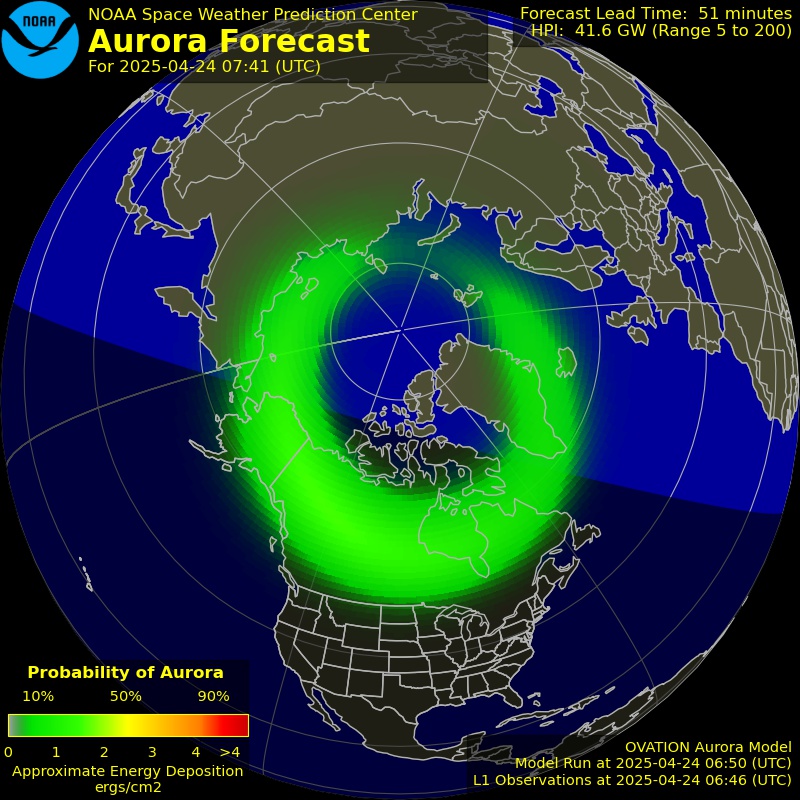
NOAA’s Northern Hemisphere 30-minute model. The illuminated band indicates modeled auroral activity, not a local camera or visibility probability.
Three-hour samples from NOAA, plotted against this region’s approximate Kp 5 planning threshold. The line is not a hard cutoff.
Where the sky actually opens: Look north over the broadest available opening, away from Bozeman's brightest light dome. Mountain walls can hide a low display even when the region's Kp line is crossed.
When the forecast is worth acting on: A green local viewing score is a regional planning signal, not confirmation Hyalite itself is clear. Compare cloud timing and the park-road situation.
Access before adventure: Forest roads, snow and avalanche terrain make speculative nighttime driving a bad trade. Stay at established accessible sites; do not chase a forecast up an unverified winter road.
Forecast coverage: This page shares the live NOAA/NWS regional model for Bozeman & Southwest, not an instrument or guaranteed sky report at Bozeman & Hyalite Canyon. Conditions at a lake, mountain, coast, or remote campsite may differ. The Kp 5 line is a planning benchmark, not a viewing probability.
Bozeman is the gateway to the Gallatin Mountains and Hyalite Canyon, which Visit Montana specifically identifies as an accessible dark-sky escape. Its southern Montana latitude demands a stronger geomagnetic signal than Glacier, and a narrow valley can conceal an otherwise visible northern arc.
This page uses Kp 5 only as an approximate regional planning benchmark. Kp is planetary, not a local guarantee. NOAA OVATION, local clouds, darkness, moonlight, light pollution and horizon quality can matter just as much.
Plan your return route first. Hyalite's trailheads, forest roads and winter conditions are not interchangeable with an open, staffed viewing venue.
Reservoir-side openings may reveal more sky than forested canyon roads; check access and which shore actually faces north.
Broader horizons outside the Bozeman light dome can outperform a mountain-walled site when the aurora remains low.
Use authorized parking and avoid narrow roadway shoulders or access beyond seasonal closures.
Go only when the Bozeman region has a credible aurora signal and a sufficiently clear dark interval. Hyalite's reduced city glare improves contrast, not the aurora's latitude; a north-facing opening matters more than simply driving farther up a canyon. Check the live NOAA/NWS signal and dark-sky window above before leaving; a viewing score is not a probability.
Hyalite Reservoir-area openings: Reservoir-side openings may reveal more sky than forested canyon roads; check access and which shore actually faces north. Plan your return route first. Hyalite's trailheads, forest roads and winter conditions are not interchangeable with an open, staffed viewing venue.
Kp 5 is an approximate planning trigger for the Bozeman & Southwest forecast region, not an observation or a cutoff. The local viewing score also uses cloud, darkness, moonlight and NOAA OVATION.
Forest roads, snow and avalanche terrain make speculative nighttime driving a bad trade. Stay at established accessible sites; do not chase a forecast up an unverified winter road. Verify the current operating hours and permissions with the destination before travel.
Look north over the broadest available opening, away from Bozeman's brightest light dome. Mountain walls can hide a low display even when the region's Kp line is crossed. Even strong solar activity is blocked by opaque cloud or insufficient darkness.
Open the full Montana northern lights tool →
The Viewing Score is a 0–100 planning index, not a percent chance. NOAA OVATION is modeled aurora signal rather than a local sighting probability. Missing live values stay missing.