Live northern lights conditions for Voyageurs, the Boundary Waters, North Shore and Minnesota.
—
Viewing score
Tonight in Voyageurs & International Falls
Loading live conditions…
Checking NOAA aurora activity, local clouds, darkness, solar wind and moonlight.
Aurora signal—
Best sky—
Peak Kp 24h—
Current Kp—
Solar wind speed—
Bz GSM—
Moon illuminated—
What this score means
The 0–100 number is our viewing score, not a percent chance. It combines NOAA space-weather signals with local NWS sky cover, darkness, moonlight and Minnesota regional thresholds.
Minnesota Regional Outlook
Northern Minnesota combines high latitude, long northern horizons and extensive dark-sky country. Cloud cover often decides whether a strong space-weather signal becomes visible.
Live aurora visual desk · Minnesota
Voyageurs, the Boundary Waters, or Lake Superior?
The far north gets the latitude advantage. A shore with a northward opening can be more useful than a darker campsite hidden behind trees.
Explore the viewing regions
Choose a marked region to update the live Viewing Score at the top of this page. Pin locations are regional reference points, not exact public parking or viewing entrances.
Loading the key-free dark map…
Select a region to see its forecast threshold and the current NOAA signal.
Some locations require a boat or overnight permission. Map markers show broad viewing regions, not precise public access points.
Find one of the viewing locations in the field guide
These are genuine places researched below. Each link opens a location-name search on OpenStreetMap; it is not a verified gate or parking-pin coordinate.
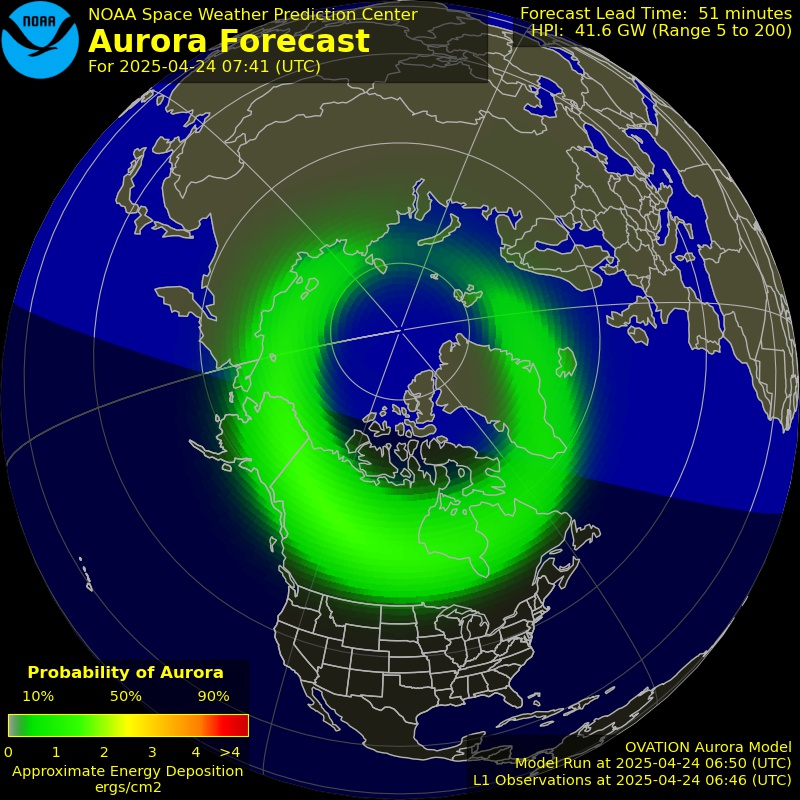
NOAA aurora oval · Northern Hemisphere
This is NOAA's current modeled auroral oval, not a live photograph or a promise of visibility. Zoom your eyes toward North America to see how far south the oval reaches.
NOAA updates its aurora nowcast independently of this page.
Every bar is a NOAA 3-hour Kp sample. The dashed line marks the planning threshold for the region you select above; it is not a visibility probability.
Waiting for NOAA forecast samples…
Below local planning KpAt/above planning KpReference level
Minnesota regional outlook: what the Kp numbers mean
These regional Kp benchmarks match the live engine above. Latitude favors International Falls, but an open northern horizon and a break in lake-effect clouds often matter more than driving an extra hour north. The estimates are trip-planning cues, not cutoffs.
Voyageurs and International Falls — Kp 3. Kabetogama, Rainy Lake and Ash River have protected dark skies, northern latitude and broad water horizons. NPS explicitly documents aurora viewing here.
Ely and Boundary Waters — Kp 4. Ely, Fall Lake and the Boundary Waters have minimal artificial light; find a public shore or approved campsite with a clear view north.
Grand Marais and Gunflint — Kp 4. Grand Marais, the Gunflint Trail and Seagull Lake are far north. Woodland and bluffs can obstruct the lowest part of the northern sky.
Bemidji and north-central — Kp 4. Bemidji and the Lake of the Woods approach have high latitude; water edges away from town glow are better than downtown lots.
Duluth and southern North Shore — Kp 5. Duluth, Two Harbors and Split Rock face lake and cloud challenges. Move away from city lights and verify which shoreline access points permit late visits.
Twin Cities and south — Kp 6. Minneapolis–St. Paul and southern Minnesota need a more expansive aurora and dark rural foreground; weak northern glows are easily washed out by metro lighting.
Where to watch the northern lights in Minnesota
These are real parks, overlooks or public-use areas, not verified open entrances tonight. A certified Dark Sky Park or Sanctuary means protected darkness, not that every viewpoint is Bortle 1 or 2. No precise Bortle class is asserted here without site measurements. Check conditions, land rules and night access before heading out.
Rainy Lake Visitor Center upper parking lot. Voyageurs NPS-designated dark-sky viewing area near International Falls; strong northern water horizon.
Meadwood Road Day Use Area. Near Ash River Visitor Center; NPS expressly names this as a designated dark-sky viewing site.
Kabetogama Lake Visitor Center boat-launch area. NPS-recommended mainland aurora spot; visitor-center building may be closed seasonally.
Ash River Visitor Center boat-launch area. A named NPS aurora-viewing spot on the Namakan/Ash River side of Voyageurs.
Fall Lake Campground area, near Ely. Real Forest Service camping and lake access on the Boundary Waters edge; verify gates and use established public access.
Seagull Lake area, Gunflint Trail. Remote lake country with little electric lighting. Use a permitted campground or public access, not private cabin frontage.
Zippel Bay State Park, Lake of the Woods. A north-facing lakeshore on the state's far northern edge; state-park hours and overnight permissions matter.
Split Rock Lighthouse State Park shoreline. Recognizable Lake Superior foreground north of Two Harbors; only use open, legal park areas during posted hours.
Best months and hours for aurora in Minnesota
September–March offers the most practical combination of dark hours and active aurora season, with October and March particularly appealing for darkness without the very shortest days. Far-northern Minnesota has short summer nights, so June and early July are poor bets for faint aurora. Watch from 9 p.m.–2 a.m. Central Time, but check the tool's actual darkness and cloud windows rather than committing to midnight. Winter shorelines can be icy and remote access roads may not be maintained.
Aurora photography basics
A tripod matters more than a long lens. Start with a wide lens, focus manually on a bright star, and shoot RAW if possible. Try a 5–10 second exposure, a wide aperture (about f/2.8), and ISO 1600–3200; shorten the shutter to 1–3 seconds if the curtains move quickly. On a phone, use its night or manual mode with the phone braced on a tripod. Check each frame for sharp stars before taking a whole sequence. Bring a red headlamp, spare batteries and warm layers; a camera can record faint color that your eyes see only as a pale glow.
Minnesota northern lights FAQ
Can I see aurora from Duluth?
Yes during sufficiently strong activity, but city lights and Lake Superior clouds can hide it. A darker legal site up the North Shore may be more useful.
What Kp is enough in Voyageurs?
Kp 3 starts the regional watch in this tool. Activity in the NOAA oval, clear skies and an unobstructed northern horizon are still necessary.
Where can I go without a boat in Voyageurs?
The Rainy Lake Visitor Center upper parking area, Meadwood Road Day Use Area, and Kabetogama/Ash River boat-launch areas are named by NPS.
Is the Boundary Waters better than a city park?
For darkness, often yes. But trees can block the horizon and some access involves permits, paddling or remote travel. Use an accessible shoreline.
What time should I look near Minneapolis?
Wait until it is fully dark and watch for strong oval expansion; 9 p.m.–2 a.m. is a sensible starting block, not a scheduled show.
Start with the score and headline, check cloud cover and the best dark window, then compare regions before traveling. Voyageurs is the statewide benchmark because of its dark northern horizons and established aurora viewing value.
Minnesota northern lights by location
Know where you plan to watch? Open a local page that locks the same live state engine to that location.
Lutsen: popular ski and trail country, with Lake Superior cloud-versus-inland dark-sky decisions.
Local planning Kp 4 · live NWS clouds + NOAA aurora
Data and truth boundaries
NOAA OVATION is a short-term modeled aurora signal and Kp is a broad geomagnetic index. Neither is a local sighting probability. Clouds, twilight, moonlight, light pollution, terrain and horizon quality can prevent a sighting. Missing live values remain missing.