Burntside and Shagawa lake areas
Open water horizons near Ely can reduce tree blockage while keeping local light relatively low.
Ely's dark sky is a major advantage. When aurora is active, the main question is often whether clouds clear and whether you have a safe open northern horizon without turning the chase into a risky remote-night drive.
Use the regional map, the latest NOAA auroral-oval model, and the real 72-hour planetary Kp forecast together with the live local cloud and darkness assessment above. They are planning tools, not a sighting guarantee.
The highlighted marker represents the Ely & Boundary Waters forecast region. Other markers are regional model reference points, not suggested parking locations. Select a marker for that area’s own forecast.

Showing the region behind this live local forecast. Map markers are broad modeling centers; use the location-name search links and check legal access before traveling.
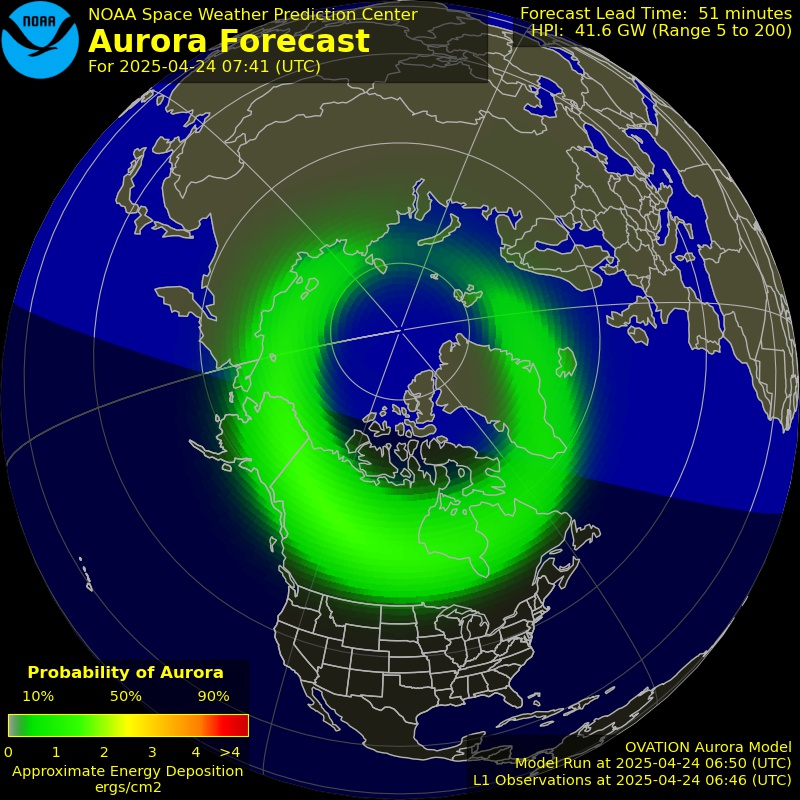
NOAA’s Northern Hemisphere 30-minute model. The illuminated band indicates modeled auroral activity, not a local camera or visibility probability.
Three-hour samples from NOAA, plotted against this region’s approximate Kp 4 planning threshold. The line is not a hard cutoff.
Where the sky actually opens: Northwoods isolation is an asset, but thick conifer forest can hide low aurora. Dark lake horizons outside Ely often work better than an enclosed trail.
When the forecast is worth acting on: Aurora can be active but invisible beneath local cloud or tree cover. Weigh the Ely regional dark window against a practical, legal lake-access viewpoint.
Access before adventure: Boundary Waters camping and boating require advance planning. Night canoe launches, unverified ice and remote unmaintained forest roads are not safe aurora shortcuts.
Forecast coverage: This page shares the live NOAA/NWS regional model for Ely & Boundary Waters, not an instrument or guaranteed sky report at Ely & Boundary Waters. Conditions at a lake, mountain, coast, or remote campsite may differ. The Kp 4 line is a planning benchmark, not a viewing probability.
Ely and the Boundary Waters sit under some of Minnesota’s darkest skies and at a favorable latitude. The lack of urban light improves faint displays, while forested terrain means an open lake or clearing is especially valuable.
This page uses Kp 4 only as an approximate regional planning benchmark. Kp is planetary, not a local guarantee. NOAA OVATION, local clouds, darkness, moonlight, light pollution and horizon quality can matter just as much.
Favor established public access with an open lake or clearing. Remote roads, cold weather and limited cell service make pre-trip planning more important here than in a city.
Open water horizons near Ely can reduce tree blockage while keeping local light relatively low.
A short move from town often materially improves contrast; use established legal access.
Extremely dark skies can be excellent, but remoteness means access and safety should be decided before the aurora peaks.
Ely's dark sky is a major advantage. When aurora is active, the main question is often whether clouds clear and whether you have a safe open northern horizon without turning the chase into a risky remote-night drive. Check the live NOAA/NWS signal and dark-sky window above before leaving; a viewing score is not a probability.
Burntside and Shagawa lake areas: Open water horizons near Ely can reduce tree blockage while keeping local light relatively low. Favor established public access with an open lake or clearing. Remote roads, cold weather and limited cell service make pre-trip planning more important here than in a city.
Kp 4 is an approximate planning trigger for the Ely & Boundary Waters forecast region, not an observation or a cutoff. The local viewing score also uses cloud, darkness, moonlight and NOAA OVATION.
Boundary Waters camping and boating require advance planning. Night canoe launches, unverified ice and remote unmaintained forest roads are not safe aurora shortcuts. Verify the current operating hours and permissions with the destination before travel.
Northwoods isolation is an asset, but thick conifer forest can hide low aurora. Dark lake horizons outside Ely often work better than an enclosed trail. Even strong solar activity is blocked by opaque cloud or insufficient darkness.
Open the full Minnesota northern lights tool →
The Viewing Score is a 0–100 planning index, not a percent chance. NOAA OVATION is modeled aurora signal rather than a local sighting probability. Missing live values stay missing.