Split Rock Lighthouse State Park Pebble Beach
Minnesota DNR identifies this shoreline cove; check whether your legal access point offers a northward opening.
Use the Duluth–southern North Shore regional outlook for the first signal, then verify Split Rock's own shoreline clouds and the direction of the accessible sky. This is a photo-location decision as much as a geomagnetic one.
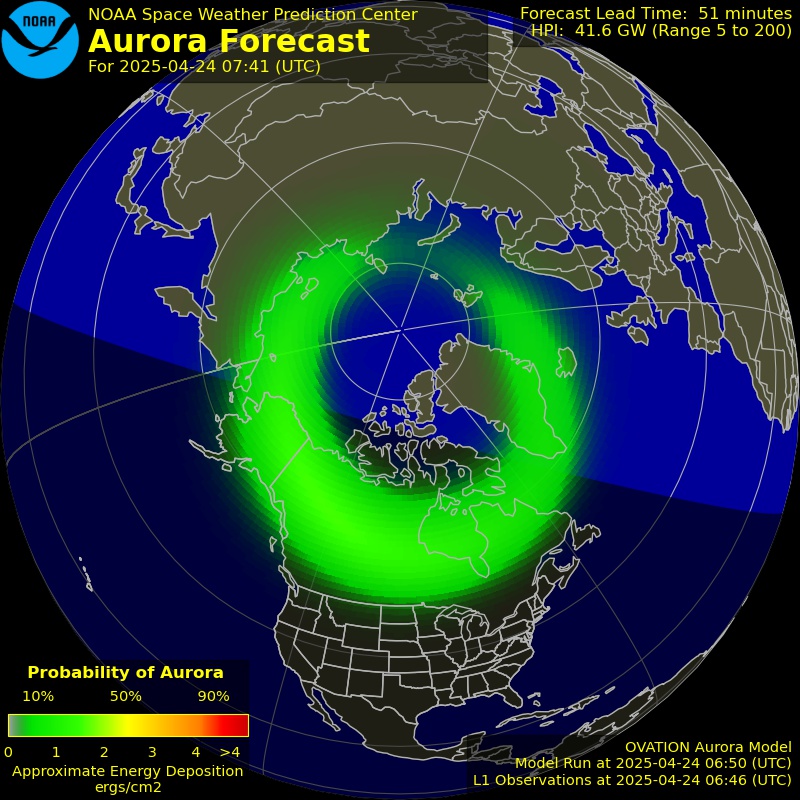
Use the regional map, the latest NOAA auroral-oval model, and the real 72-hour planetary Kp forecast together with the live local cloud and darkness assessment above. They are planning tools, not a sighting guarantee.
The highlighted marker represents the Duluth & North Shore forecast region. Other markers are regional model reference points, not suggested parking locations. Select a marker for that area’s own forecast.

Showing the region behind this live local forecast. Map markers are broad modeling centers; use the location-name search links and check legal access before traveling.
NOAA’s Northern Hemisphere 30-minute model. The illuminated band indicates modeled auroral activity, not a local camera or visibility probability.
Three-hour samples from NOAA, plotted against this region’s approximate Kp 5 planning threshold. The line is not a hard cutoff.
Where the sky actually opens: The lighthouse is a strong foreground but aurora geometry matters. Many iconic photo angles are not north-facing; do not chase a compositional shot at the cost of a usable aurora horizon.
When the forecast is worth acting on: Compare the Kp line to the North Shore outlook, then check clouds at the actual coast. A Duluth-region cloud estimate does not measure Pebble Beach.
Access before adventure: Park entry and MNHS lighthouse tours are separate. Honor seasonal paths, cliffs and lake-spray hazards; do not enter closed structures.
Forecast coverage: This page shares the live NOAA/NWS regional model for Duluth & North Shore, not an instrument or guaranteed sky report at Split Rock Lighthouse. Conditions at a lake, mountain, coast, or remote campsite may differ. The Kp 5 line is a planning benchmark, not a viewing probability.
Split Rock Lighthouse is one of Minnesota's best-known Lake Superior landmarks. The state park includes rocky shoreline and the historic lighthouse property is separately managed by the Minnesota Historical Society. A good aurora display near the horizon requires a clear view to the north, not just a dramatic photograph facing the lighthouse.
This page uses Kp 5 only as an approximate regional planning benchmark. Kp is planetary, not a local guarantee. NOAA OVATION, local clouds, darkness, moonlight, light pollution and horizon quality can matter just as much.
Do not confuse access to the state park with after-hours admission to the historic lighthouse site. The lighthouse grounds and building have their own operating rules.
Minnesota DNR identifies this shoreline cove; check whether your legal access point offers a northward opening.
Campground guests may have nearby public park trails; verify reservation and any trail closure before dark.
A signature daytime viewpoint but not a promise of nighttime access to the separate MNHS-managed landmark.
Use the Duluth–southern North Shore regional outlook for the first signal, then verify Split Rock's own shoreline clouds and the direction of the accessible sky. This is a photo-location decision as much as a geomagnetic one. Check the live NOAA/NWS signal and dark-sky window above before leaving; a viewing score is not a probability.
Split Rock Lighthouse State Park Pebble Beach: Minnesota DNR identifies this shoreline cove; check whether your legal access point offers a northward opening. Do not confuse access to the state park with after-hours admission to the historic lighthouse site. The lighthouse grounds and building have their own operating rules.
Kp 5 is an approximate planning trigger for the Duluth & North Shore forecast region, not an observation or a cutoff. The local viewing score also uses cloud, darkness, moonlight and NOAA OVATION.
Park entry and MNHS lighthouse tours are separate. Honor seasonal paths, cliffs and lake-spray hazards; do not enter closed structures. Verify the current operating hours and permissions with the destination before travel.
The lighthouse is a strong foreground but aurora geometry matters. Many iconic photo angles are not north-facing; do not chase a compositional shot at the cost of a usable aurora horizon. Even strong solar activity is blocked by opaque cloud or insufficient darkness.
Open the full Minnesota northern lights tool →
The Viewing Score is a 0–100 planning index, not a percent chance. NOAA OVATION is modeled aurora signal rather than a local sighting probability. Missing live values stay missing.