Rural areas north of Bangor and Old Town
Moving away from metro glow can improve faint northern arcs during stronger events.
Bangor can see aurora during stronger events, but a low northern display is easily lost in city glow. The useful signal is whether activity and clear sky justify driving to darker country north of the city.
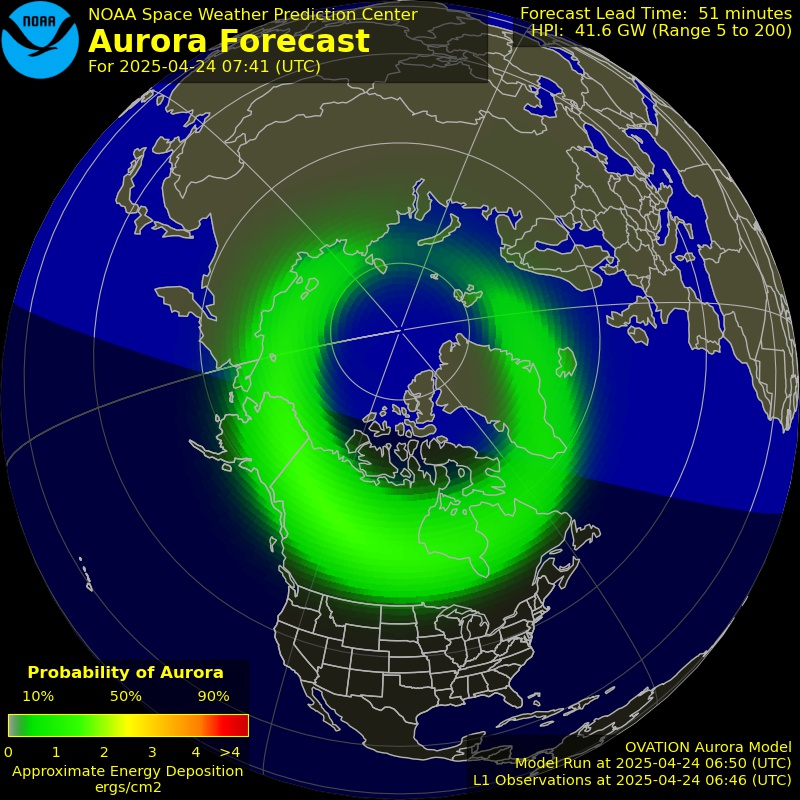
Use the regional map, the latest NOAA auroral-oval model, and the real 72-hour planetary Kp forecast together with the live local cloud and darkness assessment above. They are planning tools, not a sighting guarantee.
The highlighted marker represents the Bangor & Central forecast region. Other markers are regional model reference points, not suggested parking locations. Select a marker for that area’s own forecast.

Showing the region behind this live local forecast. Map markers are broad modeling centers; use the location-name search links and check legal access before traveling.
NOAA’s Northern Hemisphere 30-minute model. The illuminated band indicates modeled auroral activity, not a local camera or visibility probability.
Three-hour samples from NOAA, plotted against this region’s approximate Kp 6 planning threshold. The line is not a hard cutoff.
Where the sky actually opens: Bangor's city glow often overwhelms low aurora. Darker lakes and countryside north of the city can improve contrast, while cloud bands shift between the coast and inland.
When the forecast is worth acting on: Check a convincing south-reaching oval and the Bangor regional clear dark window before investing a drive. A strong event farther north may not reach the Bangor horizon.
Access before adventure: Public water access and parks vary in nighttime availability. Stay off private shore property and avoid unlit roadside shoulders.
Forecast coverage: This page shares the live NOAA/NWS regional model for Bangor & Central, not an instrument or guaranteed sky report at Bangor. Conditions at a lake, mountain, coast, or remote campsite may differ. The Kp 6 line is a planning benchmark, not a viewing probability.
Bangor sits south of Maine’s best Aroostook latitude but still benefits from quick access to dark central and northern Maine. Stronger geomagnetic activity is typically needed than in Presque Isle or Allagash.
This page uses Kp 6 only as an approximate regional planning benchmark. Kp is planetary, not a local guarantee. NOAA OVATION, local clouds, darkness, moonlight, light pollution and horizon quality can matter just as much.
Favor legal public access north of the Bangor light dome with an open horizon. Local cloud cover can differ quickly between the coast, river valleys and inland high ground.
Moving away from metro glow can improve faint northern arcs during stronger events.
Open-water horizons can help when local access is legal and conditions are safe.
Plan a destination in advance; do not rely on roadside shoulders or private land.
Bangor can see aurora during stronger events, but a low northern display is easily lost in city glow. The useful signal is whether activity and clear sky justify driving to darker country north of the city. Check the live NOAA/NWS signal and dark-sky window above before leaving; a viewing score is not a probability.
Rural areas north of Bangor and Old Town: Moving away from metro glow can improve faint northern arcs during stronger events. Favor legal public access north of the Bangor light dome with an open horizon. Local cloud cover can differ quickly between the coast, river valleys and inland high ground.
Kp 6 is an approximate planning trigger for the Bangor & Central forecast region, not an observation or a cutoff. The local viewing score also uses cloud, darkness, moonlight and NOAA OVATION.
Public water access and parks vary in nighttime availability. Stay off private shore property and avoid unlit roadside shoulders. Verify the current operating hours and permissions with the destination before travel.
Bangor's city glow often overwhelms low aurora. Darker lakes and countryside north of the city can improve contrast, while cloud bands shift between the coast and inland. Even strong solar activity is blocked by opaque cloud or insufficient darkness.
Open the full Maine northern lights tool →
The Viewing Score is a 0–100 planning index, not a percent chance. NOAA OVATION is modeled aurora signal rather than a local sighting probability. Missing live values stay missing.