Greenville-area Moosehead Lake public shoreline
A practical gateway, though direct town lighting can reduce faint contrast.
A north-facing public shore may offer better low-aurora visibility than a forested lodge. But the existing Katahdin region is only the closest available engine proxy; cloud conditions on Moosehead may differ substantially.
Use the regional map, the latest NOAA auroral-oval model, and the real 72-hour planetary Kp forecast together with the live local cloud and darkness assessment above. They are planning tools, not a sighting guarantee.
The highlighted marker represents the Katahdin Woods & Waters forecast region. Other markers are regional model reference points, not suggested parking locations. Select a marker for that area’s own forecast.

Showing the region behind this live local forecast. Map markers are broad modeling centers; use the location-name search links and check legal access before traveling.
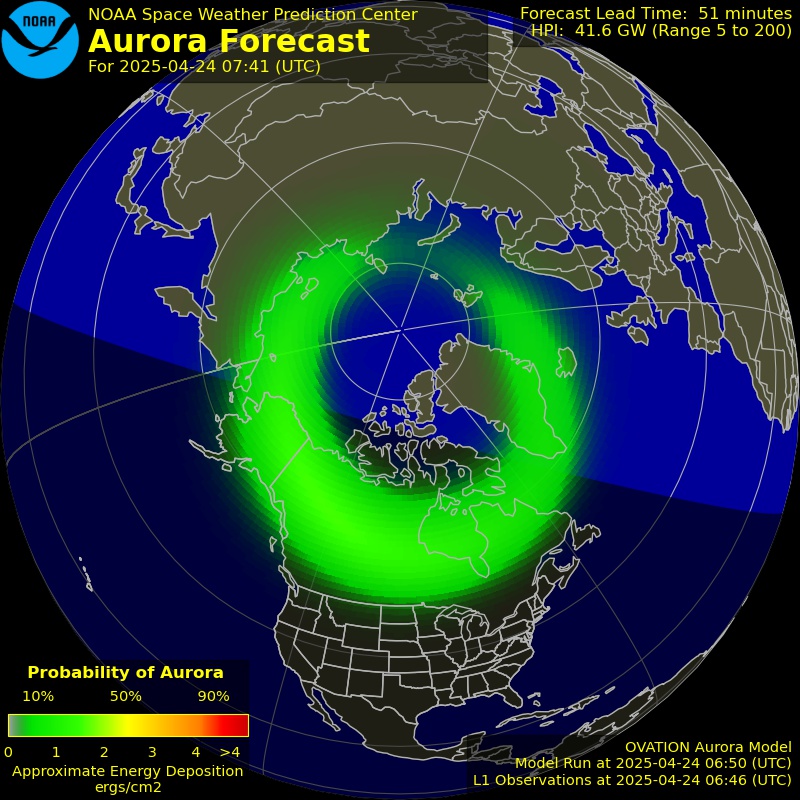
NOAA’s Northern Hemisphere 30-minute model. The illuminated band indicates modeled auroral activity, not a local camera or visibility probability.
Three-hour samples from NOAA, plotted against this region’s approximate Kp 5 planning threshold. The line is not a hard cutoff.
Where the sky actually opens: Broad water is the visual advantage but lake mist can move differently from the regional weather model.
When the forecast is worth acting on: This page is tied to the Katahdin engine rather than a Greenville NWS grid; treat the score as regional guidance only, especially when cloud is decisive.
Access before adventure: Never assume access to privately managed woodlands or water. Check gates, boat launches and current seasonal rules.
Forecast coverage: This page shares the live NOAA/NWS regional model for Katahdin Woods & Waters, not an instrument or guaranteed sky report at Moosehead Lake & Greenville. Conditions at a lake, mountain, coast, or remote campsite may differ. The Kp 5 line is a planning benchmark, not a viewing probability.
Moosehead Lake is a celebrated northwestern Maine destination for paddling, wildlife and 100-Mile Wilderness access. Its size gives potential sky openings, while Greenville's town lights and higher terrain make viewpoint placement important. Nearby AMC Maine Woods includes officially protected dark-sky lands.
This page uses Kp 5 only as an approximate regional planning benchmark. Kp is planetary, not a local guarantee. NOAA OVATION, local clouds, darkness, moonlight, light pollution and horizon quality can matter just as much.
Establish which shore or public park is actually accessible. Remote timber roads, private lots, boats and winter ice require separate safety decisions.
A practical gateway, though direct town lighting can reduce faint contrast.
Choose an actual legal site facing north; different shores produce very different horizon views.
Managed AMC lands provide dark sky but require checking reservations and access.
A north-facing public shore may offer better low-aurora visibility than a forested lodge. But the existing Katahdin region is only the closest available engine proxy; cloud conditions on Moosehead may differ substantially. Check the live NOAA/NWS signal and dark-sky window above before leaving; a viewing score is not a probability.
Greenville-area Moosehead Lake public shoreline: A practical gateway, though direct town lighting can reduce faint contrast. Establish which shore or public park is actually accessible. Remote timber roads, private lots, boats and winter ice require separate safety decisions.
Kp 5 is an approximate planning trigger for the Katahdin Woods & Waters forecast region, not an observation or a cutoff. The local viewing score also uses cloud, darkness, moonlight and NOAA OVATION.
Never assume access to privately managed woodlands or water. Check gates, boat launches and current seasonal rules. Verify the current operating hours and permissions with the destination before travel.
Broad water is the visual advantage but lake mist can move differently from the regional weather model. Even strong solar activity is blocked by opaque cloud or insufficient darkness.
Open the full Maine northern lights tool →
The Viewing Score is a 0–100 planning index, not a percent chance. NOAA OVATION is modeled aurora signal rather than a local sighting probability. Missing live values stay missing.