Katahdin Loop Road Overlook
An NPS-recommended stargazing location; park access and road conditions must be verified.
Choose the live Katahdin regional outlook first, then pair an unusually dark sky with an actual reachable northward vista. Even certified darkness does not overcome the wrong Kp latitude or a cloudy sky.
Use the regional map, the latest NOAA auroral-oval model, and the real 72-hour planetary Kp forecast together with the live local cloud and darkness assessment above. They are planning tools, not a sighting guarantee.
The highlighted marker represents the Katahdin Woods & Waters forecast region. Other markers are regional model reference points, not suggested parking locations. Select a marker for that area’s own forecast.

Showing the region behind this live local forecast. Map markers are broad modeling centers; use the location-name search links and check legal access before traveling.
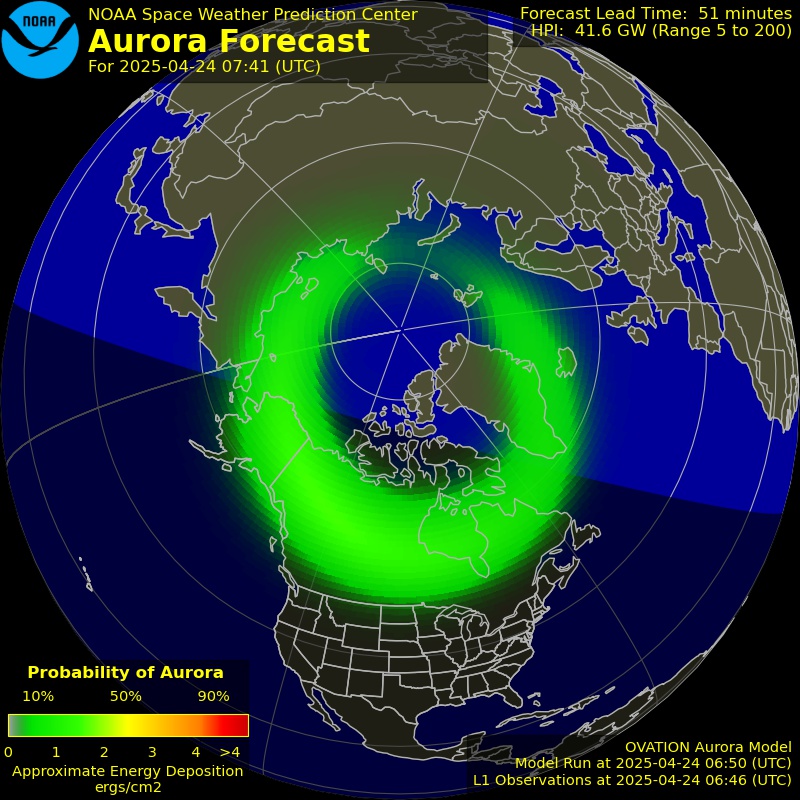
NOAA’s Northern Hemisphere 30-minute model. The illuminated band indicates modeled auroral activity, not a local camera or visibility probability.
Three-hour samples from NOAA, plotted against this region’s approximate Kp 5 planning threshold. The line is not a hard cutoff.
Where the sky actually opens: Exceptionally dark doesn’t always mean a full northern horizon; trees and hill silhouettes can conceal a low arc.
When the forecast is worth acting on: This is a real Dark Sky Sanctuary, but the region model is a planning proxy. Check NOAA oval, local cloud and whether the access window is actually possible.
Access before adventure: NPS recommends arriving by dusk. Winter routes may require skiing or snowshoeing; do not assume a car can reach the same viewpoints all year.
Forecast coverage: This page shares the live NOAA/NWS regional model for Katahdin Woods & Waters, not an instrument or guaranteed sky report at Katahdin Woods & Waters. Conditions at a lake, mountain, coast, or remote campsite may differ. The Kp 5 line is a planning benchmark, not a viewing probability.
Katahdin Woods and Waters National Monument became an International Dark Sky Sanctuary in 2020. The National Park Service confirms extraordinary naturally dark skies and occasional aurora, not nightly guaranteed displays. The monument is enormous; travel to a named viewpoint is part of the decision.
This page uses Kp 5 only as an approximate regional planning benchmark. Kp is planetary, not a local guarantee. NOAA OVATION, local clouds, darkness, moonlight, light pollution and horizon quality can matter just as much.
NPS explicitly advises choosing destinations before sunset and often staying overnight. Loop Road and other interior roads have seasonal and vehicle limitations.
An NPS-recommended stargazing location; park access and road conditions must be verified.
NPS documents this riverside night-sky location; remote access needs advance planning.
A planned overnight can avoid a risky after-dark departure; check booking and seasonal access.
Choose the live Katahdin regional outlook first, then pair an unusually dark sky with an actual reachable northward vista. Even certified darkness does not overcome the wrong Kp latitude or a cloudy sky. Check the live NOAA/NWS signal and dark-sky window above before leaving; a viewing score is not a probability.
Katahdin Loop Road Overlook: An NPS-recommended stargazing location; park access and road conditions must be verified. NPS explicitly advises choosing destinations before sunset and often staying overnight. Loop Road and other interior roads have seasonal and vehicle limitations.
Kp 5 is an approximate planning trigger for the Katahdin Woods & Waters forecast region, not an observation or a cutoff. The local viewing score also uses cloud, darkness, moonlight and NOAA OVATION.
NPS recommends arriving by dusk. Winter routes may require skiing or snowshoeing; do not assume a car can reach the same viewpoints all year. Verify the current operating hours and permissions with the destination before travel.
Exceptionally dark doesn’t always mean a full northern horizon; trees and hill silhouettes can conceal a low arc. Even strong solar activity is blocked by opaque cloud or insufficient darkness.
Open the full Maine northern lights tool →
The Viewing Score is a 0–100 planning index, not a percent chance. NOAA OVATION is modeled aurora signal rather than a local sighting probability. Missing live values stay missing.