Height of Land scenic overlook vicinity
A well-known Rangeley panorama; confirm night access, road and the real northern field of view.
Rangeley generally needs stronger activity than Maine's far north. Wait for a meaningful Kp/OVATION setup before committing to an exposed hill or remote lake, then check cloud and north-facing visibility.
Use the regional map, the latest NOAA auroral-oval model, and the real 72-hour planetary Kp forecast together with the live local cloud and darkness assessment above. They are planning tools, not a sighting guarantee.
The highlighted marker represents the Rangeley & Western Mountains forecast region. Other markers are regional model reference points, not suggested parking locations. Select a marker for that area’s own forecast.

Showing the region behind this live local forecast. Map markers are broad modeling centers; use the location-name search links and check legal access before traveling.
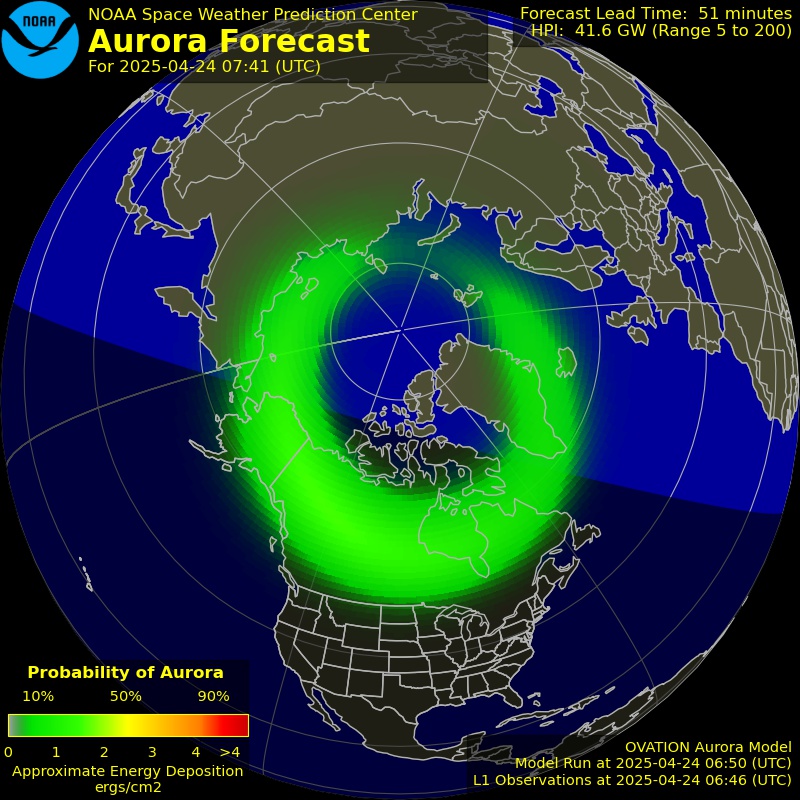
NOAA’s Northern Hemisphere 30-minute model. The illuminated band indicates modeled auroral activity, not a local camera or visibility probability.
Three-hour samples from NOAA, plotted against this region’s approximate Kp 6 planning threshold. The line is not a hard cutoff.
Where the sky actually opens: Terrain can block a low arc even under an exceptionally dark sky. Check the north view, not just general visibility.
When the forecast is worth acting on: Compare a Rangeley-specific cloud window with Kp threshold; a statewide northern Maine alert may not translate this far south.
Access before adventure: No suggested overlook is a guaranteed all-night access point. Verify seasonal road conditions and posted land-use rules.
Forecast coverage: This page shares the live NOAA/NWS regional model for Rangeley & Western Mountains, not an instrument or guaranteed sky report at Rangeley Lakes. Conditions at a lake, mountain, coast, or remote campsite may differ. The Kp 6 line is a planning benchmark, not a viewing probability.
Rangeley is famous for western Maine's mountain scenery, lakes and hiking. Visit Maine singles out the Rangeley night sky and mentions local guided night-sky tours. Mountains and shore orientation mean a panoramic daytime viewpoint is not necessarily an aurora-ready one.
This page uses Kp 6 only as an approximate regional planning benchmark. Kp is planetary, not a local guarantee. NOAA OVATION, local clouds, darkness, moonlight, light pollution and horizon quality can matter just as much.
Look for legal public overlooks or shoreline access. Snow, forest routes and seasonal trailheads can make attractive summer sites unsuitable in winter.
A well-known Rangeley panorama; confirm night access, road and the real northern field of view.
Open water can preserve sky but surrounding lights and mountain silhouettes must be considered.
Visit Maine notes guided night-sky opportunities; confirm current programs and whether a visit is bookable.
Rangeley generally needs stronger activity than Maine's far north. Wait for a meaningful Kp/OVATION setup before committing to an exposed hill or remote lake, then check cloud and north-facing visibility. Check the live NOAA/NWS signal and dark-sky window above before leaving; a viewing score is not a probability.
Height of Land scenic overlook vicinity: A well-known Rangeley panorama; confirm night access, road and the real northern field of view. Look for legal public overlooks or shoreline access. Snow, forest routes and seasonal trailheads can make attractive summer sites unsuitable in winter.
Kp 6 is an approximate planning trigger for the Rangeley & Western Mountains forecast region, not an observation or a cutoff. The local viewing score also uses cloud, darkness, moonlight and NOAA OVATION.
No suggested overlook is a guaranteed all-night access point. Verify seasonal road conditions and posted land-use rules. Verify the current operating hours and permissions with the destination before travel.
Terrain can block a low arc even under an exceptionally dark sky. Check the north view, not just general visibility. Even strong solar activity is blocked by opaque cloud or insufficient darkness.
Open the full Maine northern lights tool →
The Viewing Score is a 0–100 planning index, not a percent chance. NOAA OVATION is modeled aurora signal rather than a local sighting probability. Missing live values stay missing.